 Vfatio
: vfat APR and range width
vfat is a DeFi portfolio manager and yield aggregator. Its range-adjusted APR estimates for concentrated liquidity assume that price stays within the selected bounds. Narrower ranges can show higher annualized rates, while the pool’s tick spacing can require wider executable bounds and lower the estimate.
Updated on
Match the APR to the range it measures
- Yield table: Avg APR
- With Average selected, the estimate represents a position as wide as the average for the pool’s in-range liquidity. Its explanation identifies the range basis, income sources, and fee window.
- Pool details: Fee APR
- Swap fees only, without token rewards or a range adjustment.
- Deposit and position forms: APR
- The estimate uses the range you select and, for new deposits, your deposit amount. Deposit previews use the actual executable position range.
The same pool can therefore show different APRs across these views. The unadjusted Fee APR in pool details does not describe the return for every custom range.
Real range and Normalized comparisons
Concentrated-liquidity APR options include Average, Narrowest, and Custom range widths. For Custom (%), the methodology determines whether the comparison respects the pool’s valid tick boundaries.
- Real range
- The default Custom (%) method rounds the requested percentages outward to boundaries that the pool accepts. Wider tick spacing may require a wider range and produce a lower estimated APR.
- Normalized
- The estimate uses exact percentages around the current price without rounding to tick spacing. This supports comparisons at the same concentration, including between pools for the same token pair. The resulting range may be unavailable for deposit.
Tick spacing is the minimum number of ticks between valid range boundaries. It is distinct from the pool’s swap-fee percentage. Selecting Normalized does not change the boundaries that the pool accepts.
Price percentages and tick-based display
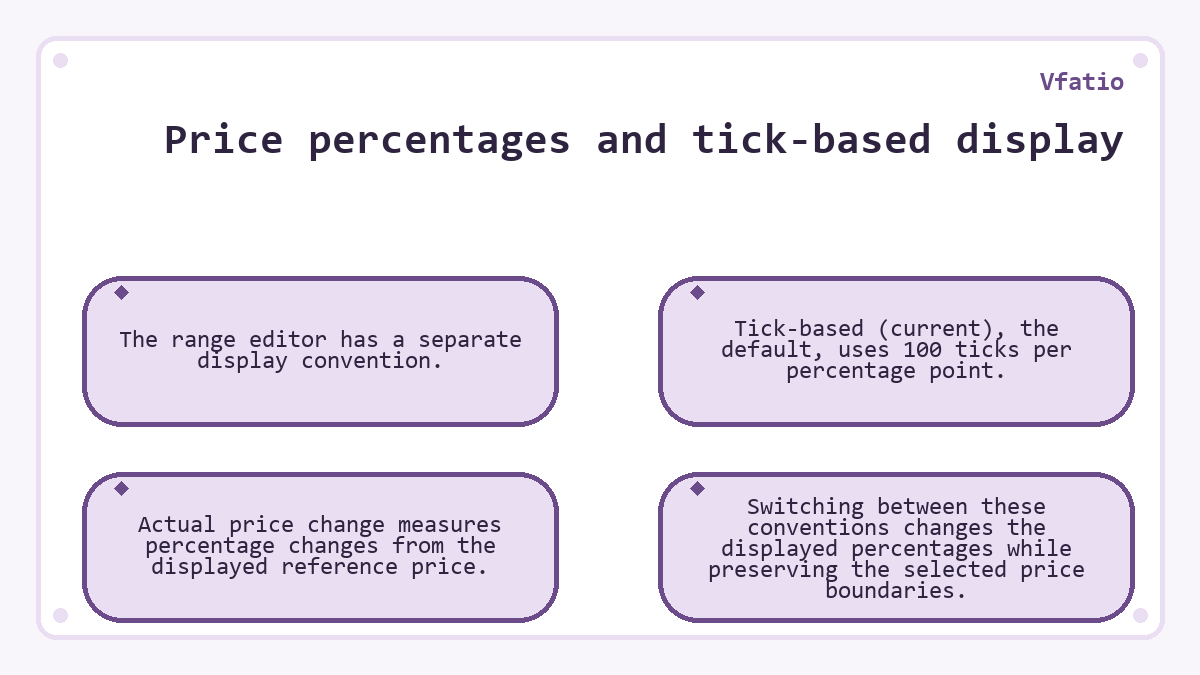
The range editor has a separate display convention. Tick-based (current), the default, uses 100 ticks per percentage point. Actual price change measures percentage changes from the displayed reference price. Switching between these conventions changes the displayed percentages while preserving the selected price boundaries.
A hypothetical range before rounding
Assume a hypothetical tick-based concentrated-liquidity pool with editable bounds, using the Actual price change convention. All price inputs and offsets here are hypothetical: reference price 137 quote tokens per base token, lower offset -7%, and upper offset +7%.
The lower target is 137 × 0.93 = 127.41 quote tokens per base token. The upper target is 137 × 1.07 = 146.59 quote tokens per base token. Measured from the lower bound, the full width is
(146.59 / 127.41 - 1) * 100
, or approximately 15.05%. That percentage measures price-range width; it does not calculate APR.
If valid ticks require Real range to round these targets outward, the executable range becomes wider. Its APR estimate can then be lower than the Normalized estimate for the same requested offsets. Once a deposit preview is available, compare its executable bounds with the calculated targets before confirming the deposit. If the rounded bounds do not fit your intended limits, revise the range before proceeding.
Smaller absolute offsets would narrow the unrounded target band. Tick spacing may prevent the executable range from shrinking by the same amount.
Limits of the range estimate
Narrowing a range does not increase flat rewards. A rate that includes token incentives therefore cannot be assumed to scale entirely with concentration; the fee and reward components retain their own calculation bases.
Neither Real range nor Normalized predicts time out of range, impermanent loss, rebalancing costs, or the effect of adding a large deposit. A higher displayed APR does not establish a higher net return.
Sorting and display settings
Range width and the Custom (%) methodology also control APR sorting and minimum/maximum APR filters across Yield results, including favorites and later pages. These settings change the comparison without modifying existing positions. The compounding display can show APY, while the filters remain expressed in APR.